long term care insurance header

...Long Term Care Insurance...

Nursing Homes and Women - You Be the Judge !

** Print out this article **

Long Term Care Insurance: Is it Basically a Women's Issue?

In recent years there has been an avalanche of media coverage regarding long term care, with the primary emphasis put on the cost of group home and nursing home confinement. The concern has almost universally been about the threat to one's assets and the impoverishment of a non-institutionalized spouse.

Although over 40% of nursing home residents are currently under age 65, the need for long term care is greatest in the over-65 population in general. Specifically in the over-85 group, where the need for formal nursing care is and will be highest.

Statistics published by the Health Insurance Association of America reveal that almost one half of the population turning age 65 will need formal nursing home confinement of some duration in their remaining years.

Roughly one fourth of the population over age 85 are in care nursing homes at any given time. By age 85, sixty one percent of people who have limitations in performing their activities of daily living are indeed in some type of care homes.

There are now about 1.5 million older Americans in nursing homes, and this figure is expected to increase a full six million by 2040. How many new nursing home beds must we add to handle these needs by the year 2030, when most of the baby boomers are retired? As many a 200 nursing home beds per day, according to the reports. It's a ticking, biological time bomb. Perod.

Mostly Women at Risk ?

The question is, however, who is really at risk here? Have you ever visited a nursing home ? Who are the nursing home residents, by and large? If your experience reflects the published reports, you found that the nursing home population consists primarily of elderly women - single, elderly women !

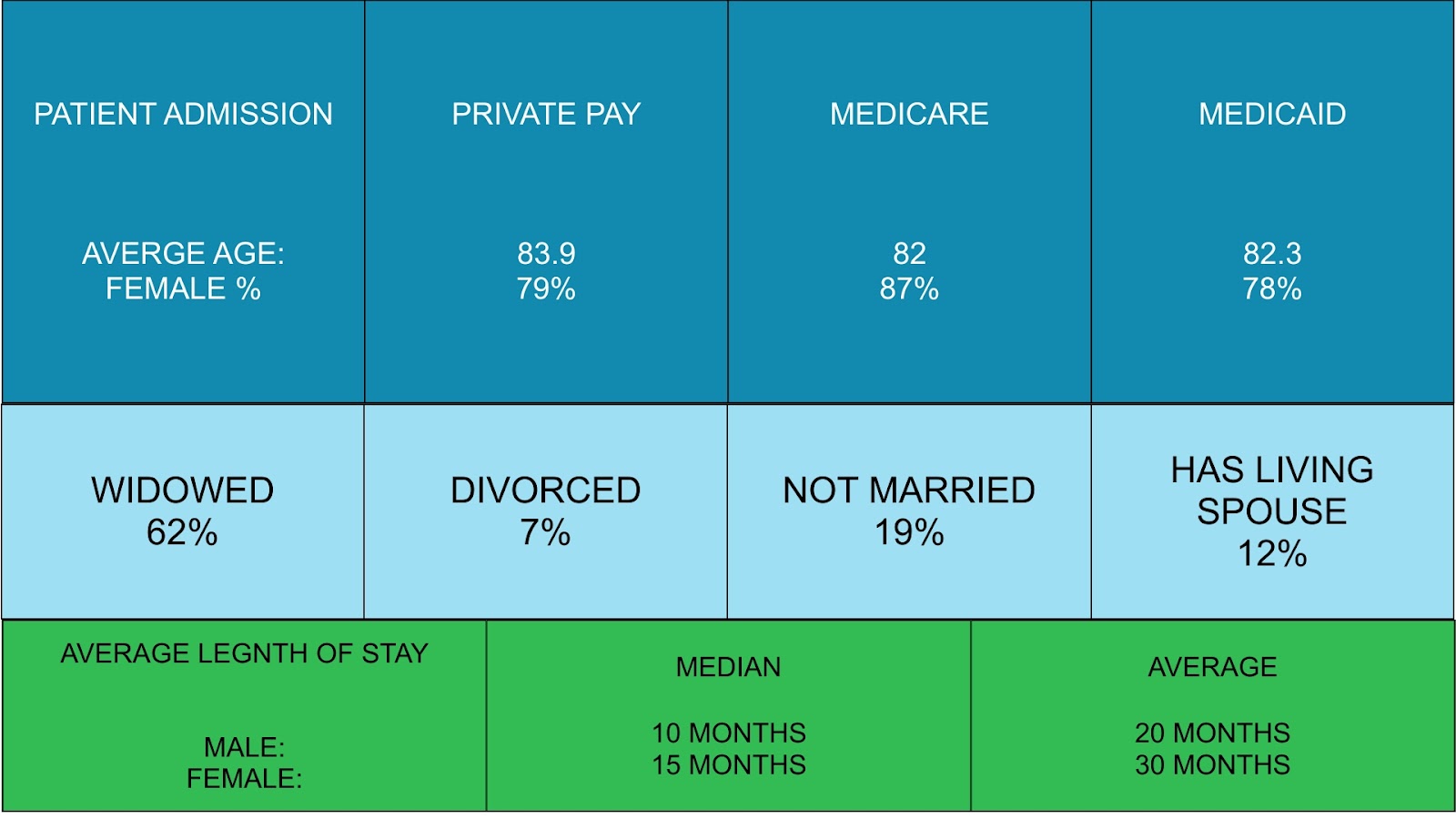
Findings of a study conducted by the Medicaid Department of the State of New York, and corroborated by the other studies, reveal the following:

 
Patient Admissions

Mean Age =

Female (%) =

Private Pay

83.9%

79%

 Medicare

82

87%

Medicaid

82.3

78%

 
 Widowed

62%

 Divorced

7%

 Never Married

19%

 A Living Spouse

12%

Average Facility Stay

Men =

Women =

 Median (mid point)

10 Months

15 Months

 Mean (average)

20 Months

30 Months

Interesting, isn't it? And most significant. Let's summarize these findings:

* Eighty percent of nursing home admissions are women.
* The average admission age of these women is 82.
* At that advanced age, most of these women are single.
* Compared to men, women are confined 50 percent longer.

Basically, men die!

If a man doesn't die suddenly, he beomes ill and his wife takes care of him until he dies. Or, his wife cares for him as long as she's able to so do. When she simply can no longer handle things, she admits him to a nursing home, and shortly thereafter he dies.

Therefore, in a nutshell, facility care is a women's problem, because women bear the most risk!

Length of Stay - Statistics

Way back in th 1990's, the Department of Health and Human Services Task Force on Long Term Care Policies published the following length of stay figures:

  31% stay
21% stay
11% stay
7% stay
5% stay
10% stay
5% stay
10% stay
1 month or less
1 to 3 months
3 to 6 months
6 to 9 months
9 to 12 months
12 to 24 months
24 to 36 months
...longer than 36 months

So, 52% of all people admitted to nursing homes stay less than 90 days, and 63% stay for less than six months. What portion of those are likely to be men? Well, since women stay 50% longer than men, we can probably surmise that a large percentage of these "short stay" residents are men.

Statistical data was reported in Contingencies magazine, published by the American Academy of Actuaries, in an article titled "Who Should Buy Long Term Care Insurance." It said that, although there is a significant risk of financial disaster for men, the predominent people at risk of losing the assets are women - single, elderly women.

With couples, there also exists a serious risk of impoverishing a non-institutionalized spouse. Indeed, there remains the distinct possiblility of nursing home "forced spend-down" or erosion of assets to pay for nursing home care - depleteing assets that otherwise might be available to pass on the family or gift to charity.

In addition, there is the issue of quality of care, and of the effects of inflation on one's ability to maintain nursing home "private pay" status. The above article assumes an inflation rate of 5%, although the inflation rate for nursing home care has been more like 16% per year. If that rate continues, how soon will people spend down all their assets for nursing home care?

Will You Have a Choice ?

And now we come to the real question. Can the people who are at most risk - primarily single, elderly women - pay for the care they would choose for themselves; i.e., will they have the freedom to choose the setting and the type of care they will want to receive?

Based on income alone, few of the single elderly can finance the cost of nursing home care, as seen in the classic illustration released in 1990:

 Annual Income

$25,000 or more
$15,000 - 24,999
$10,000 - 14,999
$ 7,000 - 9,999
$ 5,000 - 6,999
$ 4,000 - 4,999
$ 3,000 - 3,999
$ 3,000 or less
 Independent Singles
Over Age 65

7.6 %
12.5 %
15.8 %
18.2 %
22.2 %
13.4 %
6.3 %
3.9 %

Unfortunately, many of the currently elderly females have no pensions plans of any type - none based on their own work record and contributions, nor were they fortunate enough to inherit pensions from their husbands.

Those who do have pension benefits based on their own work record have very modest benefits due to the relatively low wages during their working years.

Although more women are now being covered by pension plans, the benefits they will receive will still be lower, again due to the lower wage base during their working years. Also, some reports still predict that only 10 percent of women will inherit a pension benefit from their husbands.

And that's if the company actually pays the promised pension, which is a question in itself these days, eh?

Will Things Change in the Future ?

Currently, over 60 percent of the elderly rely on Social Security to provide more than one-half of their retirement income. Roughly one out of four people over age 65 receive 90 percent or more of their income from Social Security.

What about future retirees? Will they be as dependent on Social Security during their remaining years? With the shift away from true pension plans (defined benefit plans) to contribution-type plans (401K plans) funded largely with employee dollars, will the majority of employees exhibit the necessary discipline and actually creat a significant retirement fund? The Baby Boomers have not been known for their discipline...

Going back now to the 1990 studies, women who retired on Social Security received a benefit that was $11 per month less than the poverty level.

Obviously, there was little hope then of their paying for nursing home care if they relied upon their monthly Social Security checks for a large percentage of their income.

1990 Average Social Security Benefits

Average Worker
All Retirees
New Retirees
Men
Women
Poverty Level
(Aged, Single)
Benefit
$523
$507
$605
$462

$473

The picture has not become rosier. Many of the current and future single, elderly women will have to look to other sources to pay for other nursing home care. They will have to rely on 1. public programs (Medicaid is being tightened drastically), 2. family (a tremendous caregiving challenge) or 3. private long term care insurance.

In years past, I've spoken for many groups of retirees and financial planners and one question occurs most often, "How much does it cost?"

Now, you can have the answer by submitting a simple request online - Just Get Your Free Quote Now.

With my family history of seven family members in nursing homes, I know that your family will benefit from advance planning for these eventualities. It is my belief that long term care insurance protection is in your best interest. Please get it early - while you are still healthy enough to qualify and you can lock in the lower premium rates.

Yours Most Sincerely,
Clayborne Cotton